
简单高效加密算法 TEA Go 实现
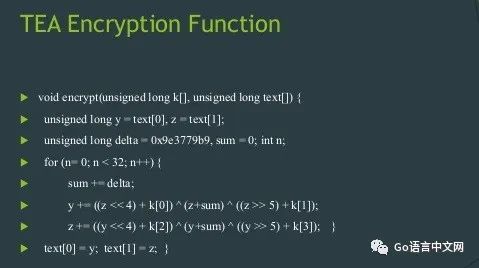
1. 什么是TEA加密算法
TEA(Tiny Encryption Algorithm)是一种简单高效的加密算法,以加密解密速度快,实现简单高效著称.
这篇文章代码有点多,如果比较关心实用性请直接查看最后一章(TEA加密算法的优势和使用案例).
在安全学领域,TEA(Tiny Encryption Algorithm)是一种分组加密算法,它的实现非常简单,通常只需要很精短的几行代码. TEA 算法最初是由剑桥计算机实验室的 David Wheeler 和 Roger Needham 在 1994 年设计的.
TEA算法使用64位的明文分组和128位的密钥,它使用Feistel分组加密框架,需要进行 64 轮迭代,尽管作者认为 32 轮已经足够了.该算法使用了一个神秘常数δ作为倍数,它来源于黄金比率,以保证每一轮加密都不相同.但δ的精确值似乎并不重要,这里 TEA 把它定义为 δ=「(√5 - 1)231」(也就是程序中的 0×9E3779B9).
1.1 算法原理
TEA加密和解密时都使用一个常量值,这个常量值为0x9e3779b, 这个值是近似黄金分割率,注意,有些编程人员为了避免在程序中直接出现”mov变量,0x9e3779b”, 以免被破解者直接搜索0x9e3779b这个常数得知使用TEA算法,所以有时会使用”sub变量,0x61C88647”代替”mov变量,0x9e3779b”,0x61C88647=-(0x9e3779b). TEA算法每一次可以操作64bit(8byte),采用128bit(16byte)作为key,算法采用迭代的形式,推荐的迭代轮数是64轮,最少32轮.
2. XTEA(TEAN)算法
XTEA - 块TEA的继任者的第一个版本,
之后 TEA 算法被发现存在缺陷,作为回应,设计者提出了一个 TEA 的升级版本——XTEA(有时也被称为“tean”). XTEA 跟 TEA 使用了相同的简单运算,但它采用了截然不同的顺序,为了阻止密钥表攻击,四个子密钥(在加密过程中,原 128 位的密钥被拆分为 4 个 32 位的子密钥)采用了一种不太正规的方式进行混合,但速度更慢了.
TEA的第三个版本XXTEA,发表于1998年,进一步提高了TEA算法的安全性.
3. TEA算法Golang代码
import (
 "crypto/cipher"
 "encoding/binary"
 "errors"
)

const (
 // TEA BlockSize 单位byte
 BlockSize = 8

 // KeySize TEA 算法 Key的byte长度.
 KeySize = 16

 // delta is the TEA key schedule 常量.
 delta = 0x9e3779b9

 // numRounds TEA算法 round 标准常量.
 numRounds = 64
)

//tea TEA加密算法.
type tea struct {
 key    [16]byte
 rounds int
}

// NewCipher 加密算法构造器,使用标准rounds, key 长度必须是 16 byte
func NewCipher(key []byte) (cipher.Block, error) {
 return NewCipherWithRounds(key, numRounds)
}


// NewCipherWithRounds 加密算法构造器,key 长度必须是 16 byte
func NewCipherWithRounds(key []byte, rounds int) (cipher.Block, error) {
 if len(key) != 16 {
  return nil, errors.New("tea: incorrect key size")
 }

 if rounds&1 != 0 {
  return nil, errors.New("tea: odd number of rounds specified")
 }

 c := &tea{
  rounds: rounds,
 }
 copy(c.key[:], key)

 return c, nil
}


//BlockSize 返回TEA block size,结果为常量. 方法来满足package "crypto/cipher" 的 Block interface
func (*tea) BlockSize() int {
 return BlockSize
}


//Encrypt 使用t.key 来加密 src参数8byte buffer内容,密文保存在dst里面.
// 注意data的长度大于block, 在连续的block上调用encrypt是不安全的,应该使用 CBC crypto/cipher/cbc.go 那种方式来encrypt
func (t *tea) Encrypt(dst, src []byte) {
 e := binary.BigEndian
 v0, v1 := e.Uint32(src), e.Uint32(src[4:])
 k0, k1, k2, k3 := e.Uint32(t.key[0:]), e.Uint32(t.key[4:]), e.Uint32(t.key[8:]), e.Uint32(t.key[12:])

 sum := uint32(0)
 delta := uint32(delta)

 for i := 0; i < t.rounds/2; i++ {
  sum += delta
  v0 += ((v1 << 4) + k0) ^ (v1 + sum) ^ ((v1 >> 5) + k1)
  v1 += ((v0 << 4) + k2) ^ (v0 + sum) ^ ((v0 >> 5) + k3)
 }

 e.PutUint32(dst, v0)
 e.PutUint32(dst[4:], v1)
}


// Decrypt 使用t.key 来解密 src参数8byte buffer内容,明文保存在dst里面.
func (t *tea) Decrypt(dst, src []byte) {
 e := binary.BigEndian
 v0, v1 := e.Uint32(src), e.Uint32(src[4:])
 k0, k1, k2, k3 := e.Uint32(t.key[0:]), e.Uint32(t.key[4:]), e.Uint32(t.key[8:]), e.Uint32(t.key[12:])

 delta := uint32(delta)
 sum := delta * uint32(t.rounds/2) // in general, sum = delta * n

 for i := 0; i < t.rounds/2; i++ {
  v1 -= ((v0 << 4) + k2) ^ (v0 + sum) ^ ((v0 >> 5) + k3)
  v0 -= ((v1 << 4) + k0) ^ (v1 + sum) ^ ((v1 >> 5) + k1)
  sum -= delta
 }

 e.PutUint32(dst, v0)
 e.PutUint32(dst[4:], v1)
}
4. XTEA算法Golang代码
block.go
package xtea

// XTEA is based on 64 rounds.
const numRounds = 64


// blockToUint32 读取8 byte 边出 2个 uint32
func blockToUint32(src []byte) (uint32, uint32) {
 r0 := uint32(src[0])<<24 | uint32(src[1])<<16 | uint32(src[2])<<8 | uint32(src[3])
 r1 := uint32(src[4])<<24 | uint32(src[5])<<16 | uint32(src[6])<<8 | uint32(src[7])
 return r0, r1
}


//uint32ToBlock 2个 uint32 边出 8 bytes
func uint32ToBlock(v0, v1 uint32, dst []byte) {
 dst[0] = byte(v0 >> 24)
 dst[1] = byte(v0 >> 16)
 dst[2] = byte(v0 >> 8)
 dst[3] = byte(v0)
 dst[4] = byte(v1 >> 24)
 dst[5] = byte(v1 >> 16)
 dst[6] = byte(v1 >> 8)
 dst[7] = byte(v1 >> 0)
}

// encryptBlock 使用XTEA加密单个8 byte block
func encryptBlock(c *Cipher, dst, src []byte) {
 v0, v1 := blockToUint32(src)

 // Two rounds of XTEA applied per loop
 for i := 0; i < numRounds; {
  v0 += ((v1<<4 ^ v1>>5) + v1) ^ c.table[i]
  i++
  v1 += ((v0<<4 ^ v0>>5) + v0) ^ c.table[i]
  i++
 }

 uint32ToBlock(v0, v1, dst)
}

// decryptBlock 使用XTEA解密单个8 byte block
func decryptBlock(c *Cipher, dst, src []byte) {
 v0, v1 := blockToUint32(src)

 // Two rounds of XTEA applied per loop
 for i := numRounds; i > 0; {
  i--
  v1 -= ((v0<<4 ^ v0>>5) + v0) ^ c.table[i]
  i--
  v0 -= ((v1<<4 ^ v1>>5) + v1) ^ c.table[i]
 }

 uint32ToBlock(v0, v1, dst)
}
cipher.go
package xtea

import "strconv"

// XTEA block size in bytes.
const BlockSize = 8

// A Cipher is an instance of an XTEA cipher using a particular key.
type Cipher struct {
 // table contains a series of precalculated values that are used each round.
 table [64]uint32
}
// KeySizeError 自定义错误
type KeySizeError int
// Error .
func (k KeySizeError) Error() string {
 return "crypto/xtea: invalid key size " + strconv.Itoa(int(k))
}

// NewCipher 构造器.
// key 只能长度 16 bytes.
func NewCipher(key []byte) (*Cipher, error) {
 k := len(key)
 switch k {
 default:
  return nil, KeySizeError(k)
 case 16:
  break
 }

 c := new(Cipher)
 initCipher(c, key)

 return c, nil
}

//BlockSize 返回XTEA block size,结果为常量. 方法来满足package "crypto/cipher" 的 Block interface
func (c *Cipher) BlockSize() int { return BlockSize }


// Encrypt 加密 src参数8byte buffer内容,明文保存在dst里面.
// 注意data的长度大于block, 在连续的block上调用encrypt是不安全的,应该使用 CBC crypto/cipher/cbc.go 那种方式来encrypt
func (c *Cipher) Encrypt(dst, src []byte) { encryptBlock(c, dst, src) }

// Decrypt decrypts the 8 byte buffer src using the key and stores the result in dst.
// Decrypt 使用t.key 来解密 src参数8byte buffer内容,明文保存在dst里面.

func (c *Cipher) Decrypt(dst, src []byte) { decryptBlock(c, dst, src) }

// initCipher 把key转换成计算好的table
func initCipher(c *Cipher, key []byte) {
 // Load the key into four uint32s
 var k [4]uint32
 for i := 0; i < len(k); i++ {
  j := i << 2 // Multiply by 4
  k[i] = uint32(key[j+0])<<24 | uint32(key[j+1])<<16 | uint32(key[j+2])<<8 | uint32(key[j+3])
 }

 // Precalculate the table
 const delta = 0x9E3779B9
 var sum uint32

 // Two rounds of XTEA applied per loop
 for i := 0; i < numRounds; {
  c.table[i] = sum + k[sum&3]
  i++
  sum += delta
  c.table[i] = sum + k[(sum>>11)&3]
  i++
 }
}
5. TEA加密算法的优势和使用案例
TEA(Tiny Encryption Algorithm)是一种简单高效的加密算法,以加密解密速度快,实现简单高效著称. 算法真的很简单,TEA算法每一次可以操作64-bit(8-byte), 采用128-bit(16-byte)作为key,算法采用迭代的形式,推荐的迭代轮数是64轮,最少32轮.
5.1 基本单元测试
import (
 "bytes"
 "crypto/cipher"
 "crypto/rand"
 "encoding/base64"
 "errors"
 "fmt"
 "golang.org/x/crypto/tea"
 "golang.org/x/crypto/xtea"
 "io"
 "testing"
)

func TestTeaDemo(t *testing.T) {


 key := []byte("mojotv.cn.=.good")//长度必须为16byte
 c, err := tea.NewCipherWithRounds(key, 8)
 if err != nil {
  t.Fatal(err)
 }
 raw := []byte("mojotvcn")//长度必须为8byte
 dst := make([]byte,8)//长度必须为8byte
 c.Encrypt(dst,raw)
 raw2 := make([]byte,8)//长度必须为8byte
 c.Decrypt(raw2,dst[:])

 if !bytes.Equal(raw,raw2){
  t.Error("失败")
 }
 t.Log("验证成功")
}
func TestXteaDemo(t *testing.T) {

 key := []byte("mojotv.cn.=.good")//长度必须为16byte
 c, err := xtea.NewCipher(key)
 if err != nil {
  t.Fatal(err)
 }
 raw := []byte("mojotvcn")//长度必须为8byte
 dst := make([]byte,8)//长度必须为8byte
 c.Encrypt(dst,raw)
 raw2 := make([]byte,8)//长度必须为8byte
 c.Decrypt(raw2,dst[:])

 if !bytes.Equal(raw,raw2){
  t.Error("失败")
 }
 t.Log("xtea验证成功")
}
5.2 XTea和CBC Base64Url编码一起使用
TEA加密算法只需要把下面代码稍微修改一下即可. mojocn/alg-tea[1]
//使用PKCS7进行填充
func pKCS7Padding(ciphertext []byte, blockSize int) []byte {
 padding := blockSize - len(ciphertext) % blockSize
 padtext := bytes.Repeat([]byte{byte(padding)}, padding)
 return append(ciphertext, padtext...)
}
//使用PKCS7进行填充 复原
func pKCS7UnPadding(origData []byte) []byte {
 length := len(origData)
 unpadding := int(origData[length-1])
 return origData[:(length - unpadding)]
}

//XteaCbcEncrypt key 长度必须为16 byte
func XteaCbcEncrypt(rawData,key []byte) ([]byte, error) {
  block, err := xtea.NewCipher(key)
 if err != nil {
  return nil,fmt.Errorf("key 只能为16bytes, %v",err)
 }

 //填充原文
 blockSize := block.BlockSize()
 rawData = pKCS7Padding(rawData, blockSize)
 //初始向量IV必须是唯一,但不需要保密
 cipherText := make([]byte,blockSize+len(rawData))
 //block大小 16
 iv := cipherText[:blockSize]
 if _, err := io.ReadFull(rand.Reader,iv); err != nil {
  panic(err)
 }

 //block大小和初始向量大小一定要一致
 mode := cipher.NewCBCEncrypter(block,iv)
 mode.CryptBlocks(cipherText[blockSize:],rawData)

 return cipherText, nil
}
//XteaCbcDecrypt key 长度必须为16 byte
func XteaCbcDecrypt(encryptData, key []byte) ([]byte,error) {
 block, err := xtea.NewCipher(key)
 if err != nil {
  return nil,fmt.Errorf("key 只能为16bytes, %v",err)
 }

 blockSize := block.BlockSize()

 if len(encryptData) < blockSize {
  return nil,errors.New("ciphertext too short")
 }
 iv := encryptData[:blockSize]
 encryptData = encryptData[blockSize:]

 // CBC mode always works in whole blocks.
 if len(encryptData)%blockSize != 0 {
  return nil,errors.New("ciphertext is not a multiple of the block size")
 }

 mode := cipher.NewCBCDecrypter(block, iv)

 // CryptBlocks can work in-place if the two arguments are the same.
 mode.CryptBlocks(encryptData, encryptData)
 //解填充
 encryptData = pKCS7UnPadding(encryptData)
 return encryptData,nil
}


func XteaB64urlEncrypt(rawData,key []byte) (string,error) {
 data, err:= XteaCbcEncrypt(rawData,key)
 if err != nil {
  return "",err
 }
 return base64.RawURLEncoding.EncodeToString(data),nil
}

func XteaB64urlDecrypt(rawData string,key []byte) (string,error) {
 data,err := base64.RawURLEncoding.DecodeString(rawData)
 if err != nil {
  return "",err
 }
 dnData,err := XteaCbcDecrypt(data,key)
 if err != nil {
  return "",err
 }
 return string(dnData),nil
}


func TestXteaCbcB64url(t *testing.T) {
 key := []byte("mojotv.cn.=.good")//长度必须为16byte
 raw := "mojotv.cn and golang are great friends" //可以是任意长度的 []byte
 ciper,err := XteaB64urlEncrypt([]byte(raw),key)
 if err != nil {
  t.Error("xtea cbc base64 url 加密失败",err)
  return
 }
 decrypt, err := XteaB64urlDecrypt(ciper, key)
 if err != nil {
  t.Error("xtea cbc base64 url 解密失败",err)
  return
 }
 if decrypt != raw {
  t.Error("解密结果不正确")
 }
}
Github Action 单元测试执行结果[2]
=== RUN   TestTeaDemo
    tea_test.go:32: 验证成功
--- PASS: TestTeaDemo (0.00s)
=== RUN   TestXteaDemo
    tea_test.go:50: xtea验证成功
--- PASS: TestXteaDemo (0.00s)
=== RUN   TestXteaCbcB64url
--- PASS: TestXteaCbcB64url (0.00s)
PASS
ok   mojotv.cn/flash 0.005s
原文链接:https://mojotv.cn/golang/encrypt-tea-xtea-simple-efficient
作者:Eric Zhou
参考资料
mojocn/alg-tea: https://github.com/mojocn/alg-tea/blob/master/tea_test.go
[2]Github Action 单元测试执行结果: https://github.com/mojocn/alg-tea/runs/1074969486?check_suite_focus=true
推荐阅读